Top 10 Trends in the CNC Laser Industry in 2026
The CNC laser industry is experiencing a new wave of innovation as manufacturers seek greater precision, faster production cycles, and improved operational efficiency. With increasing demand from industries such as automotive, aerospace, electronics, construction, and metal fabrication, laser technology continues to evolve at an impressive pace.
In 2026, CNC laser systems are becoming smarter, more connected, and more capable than ever before. Businesses that stay informed about these developments can make better investment decisions and remain competitive in a rapidly changing manufacturing environment.
Here are the TOP 10 TRENDS IN CNC LASER INDUSTRY IN 2026
1. Increased Adoption of Smart Manufacturing
Smart manufacturing is transforming production facilities worldwide. Modern CNC laser machines are now designed to communicate with other equipment and management systems through connected digital networks.
These intelligent manufacturing environments help businesses:
- Monitor production performance
- track machine utilization
- improve workflow coordination
- reduce process inefficiencies
The result is greater visibility across operations and more informed decision-making.
2. Artificial Intelligence-Powered Optimization
Artificial intelligence is becoming a valuable component of advanced CNC laser systems.
AI-driven software can analyze production data and automatically recommend operational improvements. These systems assist manufacturers by:
- optimizing cutting parameters
- identifying production bottlenecks
- improving material utilization
- supporting predictive maintenance
This trend is helping businesses achieve better productivity while reducing manual adjustments.
3. Growth of High-Power Fiber Laser Systems
The growing adoption of fiber laser equipment is driven by its ability to support demanding production requirements while maintaining excellent cutting quality.
In 2026, manufacturers are increasingly investing in higher-power laser systems capable of handling demanding industrial applications. These machines enable fabricators to process thicker materials while maintaining excellent edge quality and production consistency.
The growing popularity of high-power fiber lasers reflects the industry’s focus on productivity and versatility.
4. Advanced Automation Solutions
Automation remains one of the strongest drivers of innovation in CNC laser manufacturing.
modern systems now include:
- automatic loading mechanisms
- automated unloading systems
- robotic material handling
- integrated production scheduling
These capabilities reduce manual intervention and support continuous operation in high-volume manufacturing environments.
5. Predictive Maintenance Technologies
Unexpected equipment downtime can significantly affect production schedules and profitability.
Manufacturers are implementing advanced condition-monitoring technologies that help detect performance irregularities and support proactive maintenance planning. sensors continuously monitor machine performance and identify potential issues before they develop into major problems.
This proactive approach helps manufacturers:
- reduce unexpected stoppages
- improve equipment availability
- lower maintenance expenses
- extend machine lifespan
6. Enhanced Software Integration
Software plays a critical role in modern CNC laser operations.
New-generation systems offer stronger integration between:
- design platforms
- production planning software
- manufacturing execution systems
- quality management tools
This connected environment improves workflow efficiency and reduces communication gaps between departments.
7. Greater Focus on Energy Efficiency
Manufacturers are paying closer attention to operational sustainability and energy management.
New CNC laser technologies are being developed with features that help optimize power consumption without compromising performance.
businesses benefit through:
- reduced operating expenses
- improved resource utilization
- lower environmental impact
Energy-conscious production practices are becoming an important competitive advantage.
8. Expansion of Customized Manufacturing
Customer demand for specialized products continues to grow across multiple industries.
Modern CNC laser systems provide the flexibility needed to support:
- short production runs
- custom fabrication projects
- rapid design modifications
- personalized manufacturing requirements
This capability allows businesses to respond quickly to changing market demands.
9. Improved Precision and Process Control
Manufacturers increasingly require tighter tolerances and greater consistency in production.
Advancements in laser control systems are helping achieve:
- enhanced dimensional accuracy
- improved repeatability
- smoother cut quality
- more stable production performance
These improvements are particularly valuable in industries where precision is critical.
10. Digital Twin Technology Adoption
Digital twin technology is emerging as a powerful tool in manufacturing.
A digital twin creates a virtual representation of a physical machine, allowing manufacturers to simulate operations and analyze performance before implementing changes.
benefits include:
- process optimization
- reduced testing costs
- faster troubleshooting
- improved production planning
As digital transformation accelerates, digital twins are expected to play a larger role in CNC laser operations.
How These Trends Are Transforming Manufacturing
The combined impact of these innovations is creating a new generation of manufacturing facilities that are:
- more productive
- more efficient
- highly connected
- increasingly automated
Businesses adopting these technologies can improve competitiveness while meeting evolving customer expectations.
Why Innovation Matters When Choosing CNC Laser Equipment
Investing in CNC laser technology is no longer just about purchasing a machine. Businesses should prioritize equipment designed to accommodate future expansion, technological advancements, and shifting manufacturing needs.
Companies should evaluate:
- automation capabilities
- software compatibility
- scalability
- support services
- technological roadmap
Choosing equipment with future-ready features can help maximize long-term value.
How Essell Supports Modern CNC Laser Manufacturing
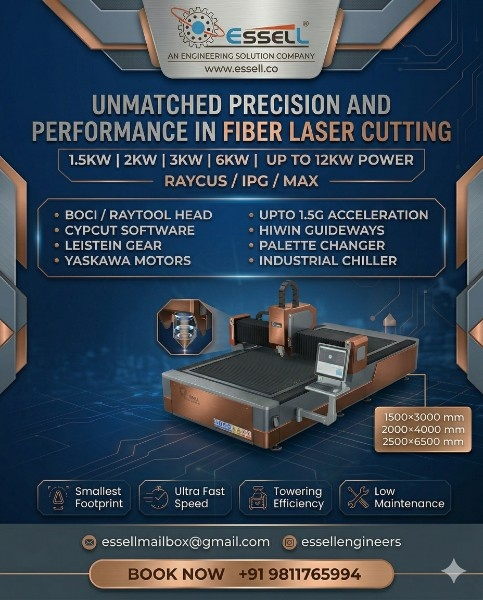
At essell. Innovation remains at the center of every solution. essell develops advanced CNC laser systems designed to support the changing needs of modern manufacturers.
Essell Solutions delivers:
- precision-focused engineering
- advanced automation capabilities
- reliable machine performance
- energy-conscious operation
- dependable technical support
Through continuous technology development and customer-focused solutions, essell helps businesses prepare for the future of manufacturing.
Conclusion
The CNC laser industry in 2026 is being shaped by automation, artificial intelligence, smart manufacturing, predictive maintenance, and advanced fiber laser technologies. The latest advancements are transforming industrial operations by enabling smarter workflows, improved resource utilization, and more consistent results.
Organizations that understand and embrace these trends will be better positioned to compete in an increasingly technology-driven marketplace. by investing in advanced solutions and partnering with trusted providers like essell, businesses can build a stronger foundation for long-term growth and manufacturing success.